Lewis concludes in Chapter 1 of Mere Christianity (1952) with two points, "First, that human beings,all over the earth, have this curious idea that they ought to behave in a certain way, and cannot really get rid of it. Secondly, that they do not in fact behave in that way. They know the Law of Nature; they break it. These two facts are the foundation of all clear thinking about ourselves and the universe we live in (Lewis, 1952, p.8).
Having read that, I start to try and understand what this means to me and my work. From reading this, it seems as if there is a moral standard/code that we as human beings adhere to - I agree with Lewis. With that, how does this standard apply to and translate to art? Is there a standard that we are trying to achieve in making art? I hear a lot of talk these days about how art can be anything we want. Is this because there was/is a standard but in our human nature have decided to break the Law of Nature? Is art supposed to break rules or point to a standard? It is the intent of the artist that matters; which to some extent, I agree. However, I start to wonder what is art then? I am interested in having these conversations. We are all getting a Master of Fine Arts degree, but we never talk about this in a real way. We all just say we make art, but why? If what Lewis is saying is true, it seems as if there must be some rules about art that we strive to adhere to as well. However, as he said, it is our choice to adhere to them or not. If art is a depiction of our values, worldview, etc. what are we communicating?
I am thinking about these topics in what I do. I strive for my work to adhere to a standard and depict my values and worldview, but how are those things being communicated? I am asking myself, am I being successful? I think art should lead viewers to consider something greater than themselves and maybe question their current view of the topic being addressed by the artist. This is all for a purpose so that we can grow, work together, and come closer to understanding truth in this world. I do not believe it is relative.
Lewis, C.S. (1952). Mere Christianity. New York, NY: HarperCollins Publishers.
I will close with a quote from artist Mako Fujimura that I have been thinking about,
"We are today, border-less in more ways than one. As we have become multi-cultural, we have become "multi-phrenic." There is no true, lasting expression of the sublime in a center-less world. If there is no center, there is no periphery border in which art can thrive. Today we need a centralizing vision of our being" (Fujimura, 2007, p.5).
This is an interesting concept - one that I am trying to wrap my mind around. If there is no center, there are no boarders? Webster defines border as "a boundary between places" or "an outer part or edge." With that I ask the question, do we need borders in art? If we do need borders - why? If borders are defined by the center, what is the center? If one says that borders are not necessary, does that mean that a center is not necessary?
Fujimura, Makoto (2007). River Grace. New York: Poiema Press: International Arts Movement.
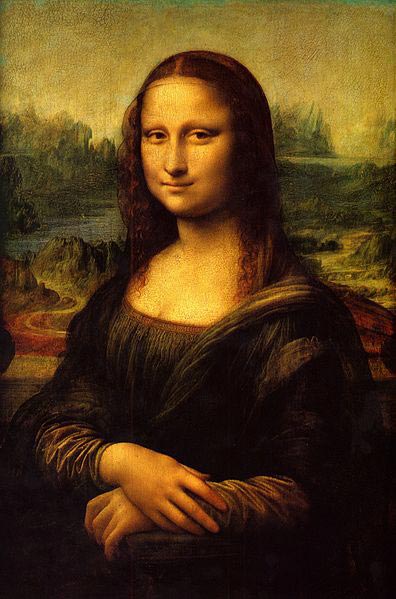
Mona Lisa by Leonardo da Vinci (1503-1517)

